

-1024x576.jpg)
-1024x576.jpg)
-1024x576.jpg)
-1024x576.jpg)
-1024x576.jpg)
-1024x576.jpg)
-1024x576.jpg)
Index for
slide deck
Title
-1024x576.jpg)
Fundamentals of Neurobiology
To understand psychiatric disorders, it is important to have a working understanding of the normal structure and function of the nervous system.
Introduction to neurobiology
-1024x576.jpg)
Introduction to neurobiology
-1024x576.jpg)
Organisation of the nervous system
!--?xml version="1.0" encoding="UTF-8" standalone="yes"?-- To understand psychiatric disorders, it is important to have a working understanding of the normal structure and function of the nervous system. The central nervous system (CNS; brain, spinal cord) and peripheral …
-1024x576.jpg)
Neurones
!--?xml version="1.0" encoding="UTF-8" standalone="yes"?-- The neurone constitutes the functional unit of the nervous system; there are over 100 billion neurones in the brain.[1,2,5] Each neurone has the ability to interact with and influence many other cells, which creat…
-1024x576.jpg)
Anatomical regions of the brain
!--?xml version="1.0" encoding="UTF-8" standalone="yes"?-- The brain is divided into four anatomical regions: the diencephalon, brainstem, cerebrum, and cerebellum, as described on the slide.[1,2]
References:
[1] Kandel ER, Schwartz JH, Jessell TM (eds). Principles of Ne…
-1024x576.jpg)
Cerebrum
!--?xml version="1.0" encoding="UTF-8" standalone="yes"?-- The cerebral cortex is the main functional unit of the cerebrum.[2] The three main functional areas of the cerebral cortex are:[1,2]
- motor areas that control voluntary movement (primary, secondary, and associatio…
-1024x576.jpg)
Lobes of the brain
!--?xml version="1.0" encoding="UTF-8" standalone="yes"?-- The brain can be thought of as comprising five ‘lobes’ – the four lobes of the cerebral cortex and a fifth lobe, the insula, deep within the brain, as shown on the slide.[1,2,3] The lobes of the cerebral cortex ar…
Neurosynaptic transmission
-1024x576.jpg)
Neurosynaptic transmission
-1024x576.jpg)
Neurotransmission
!--?xml version="1.0" encoding="UTF-8" standalone="yes"?-- Information moves through the nervous system via two integrated forms of communication – electrical neurotransmission and chemical neurotransmission, as shown on the slide.[1]
An action potential is generated at t…
-1024x576.jpg)
The synapse
!--?xml version="1.0" encoding="UTF-8" standalone="yes"?-- Neurones do not physically touch one another; two neurones are separated by a gap, known as a synaptic cleft.[1] Because neurones do not touch, and an action potential cannot ‘jump’ across a synaptic cleft, the si…
-1024x576.jpg)
Process of chemical neurotransmission
!--?xml version="1.0" encoding="UTF-8" standalone="yes"?-- The idea that neurotransmission occurs at synapses and is mediated by chemicals was, at first, a contentious issue.[1] It was in the first half of the 1900s that experiments proved chemical neurotransmission occur…
Related content
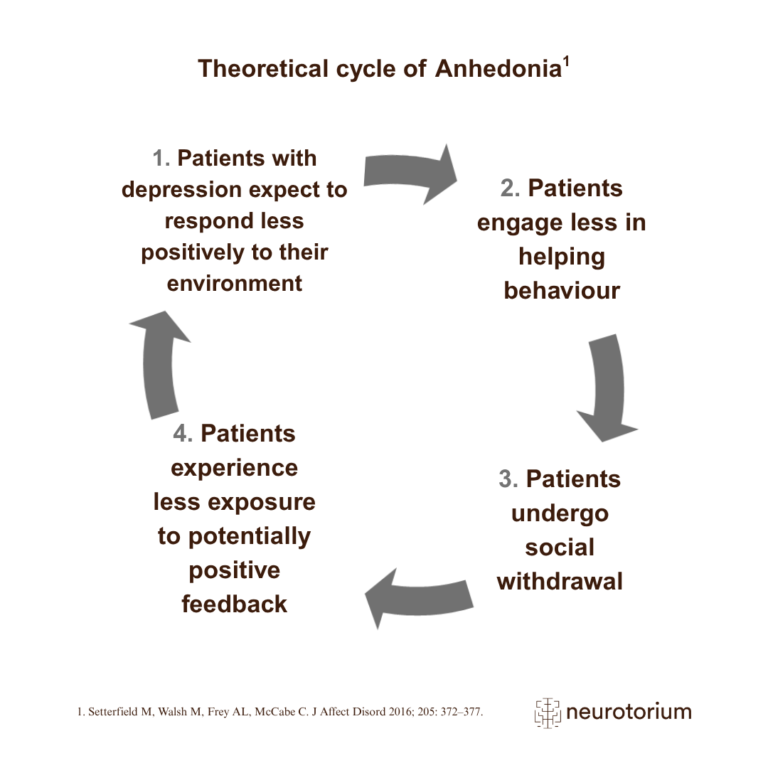
One hypothesis of the cycle of anhedonia (loss of interest or pleasure) in patients with depression is illustrated in this image; this hypothesis comes from a series of experiments performed on a sample of psychology students.
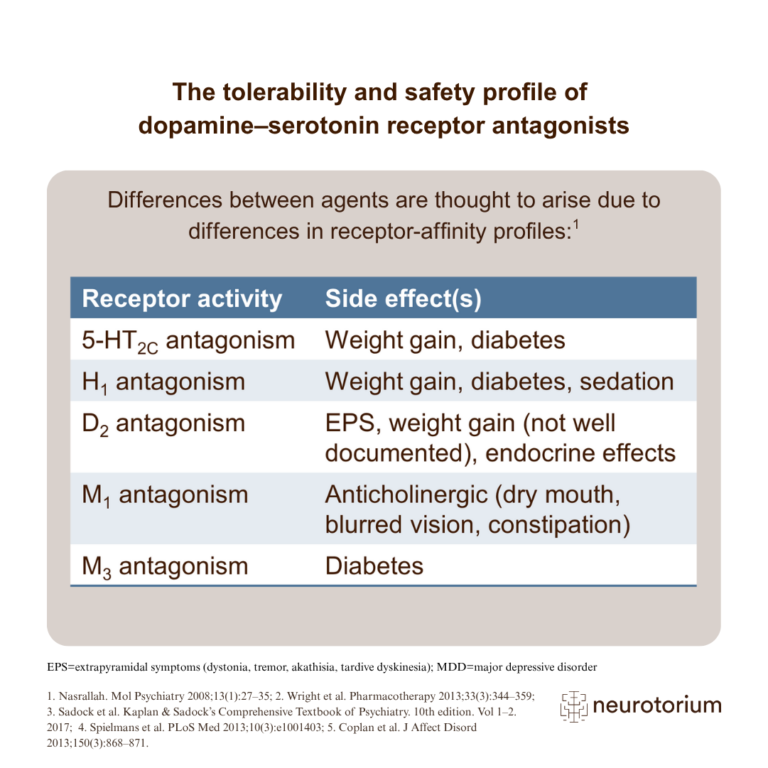
As adjunctive treatment in MDD, some dopamine–serotonin receptor antagonists are associated with sedating side effects, while others are more often associated with ‘activating’ side effects.